

That evening, the Luhan winter palace shone as if light mattered there more than people. Chandeliers burned with full golden brilliance, reflecting in the marble floors and mirrors, and it seemed that even the shadows existed only with society’s permission. The music flowed softly and confidently, as if it knew it would be listened to. Laughter was polished, glances measured, movements rehearsed in advance.
Here, people knew how to be flawless.
And especially — how not to notice.
Carriages arrived one after another at the main staircase. Ladies stepped out, lifting their gowns, gentlemen offered their hands, servants opened doors, and the entire gleaming mechanism worked without disruption. Everyone knew their place. Everyone knew whom to greet — and whom to pass with a polite expression.
Emilia Robles entered the hall almost unnoticed. Her sky-blue dress was not new — a trained eye would notice the alterations, the careful seams, the slightly changed waistline. It had not been sewn by a fashionable city dressmaker, but by her mother’s patient, tired hands. Yet there was neither haste nor any desire to prove anything in Emilia’s movements. She held herself upright and calm, as if she carried not a dress, but her dignity.
“Remember,” Doña Soledad whispered, squeezing her hand before they entered, “you don’t have to dazzle. Just be yourself. That’s enough.”
Emilia nodded. She knew that in this hall, “enough” was a rare word. Young, without a dowry, with a surname that opened no doors, she was used to being part of the background. But that evening, her heart tightened not because of herself.
In a distant corner of the hall, by a tall window, sat a man surrounded by too much empty space. Don Álvaro de Valcárcel, a duke whose name everyone knew. His figure was impeccably composed: a dark tailcoat, a light waistcoat, a perfectly straight posture. Beside his chair — a cane. His pale gray eyes were open… and empty.
He was not looking.
He was listening.
Around him there was no mockery, no exaggerated pity. There was something colder — carefully maintained avoidance. Young women changed direction the moment they noticed him. Men looked away, as if afraid to break an unspoken rule. No one sat beside him. No one started a conversation. No one invited him to dance.
“They say he lost his sight after a serious illness,” whispered one lady behind her fan.
“They say he became a difficult man,” came the reply. “He makes things awkward.”

“They say…” Emilia thought.
How easily that phrase can close someone’s life.
The music changed — a waltz began. Couples swirled, the hall filled with motion. Only the duke remained still, as if he were not part of the evening but merely its observer.
When it was announced that ladies without partners could step forward, Emilia felt her mother’s gaze. Doña Soledad said nothing — she only looked with the kind of trust that needs no words.
Emilia took a breath.
And moved.
She crossed the hall, feeling the air change. First curiosity. Then surprise. Then tense silence. The music continued, but conversations faded. When Emilia stopped in front of the duke, the silence became complete.
“Your Highness,” she said calmly.
He turned his head precisely toward her voice. His face remained composed, but there was alertness in the movement — the instinct of someone used to being observed rather than included.
“Good evening,” he replied. “Forgive me… whom do I have the honor of addressing?”
“Emilia Robles.”
She added no titles. She had none.
“Your Highness,” she continued, extending her hand, “would you grant me this waltz?”
Her hand lingered in the air. Fans froze. Even the orchestra seemed to soften.
“You understand,” the duke said quietly, “that at this moment everyone is looking at you?”
“Yes,” Emilia replied. “But all evening they have been looking at you. And no one came.”
A pause fell between them — brief, yet heavy. Then his hand slowly rested in hers.
“If you are ready to endure those gazes,” he said, “I accept.”
He rose with unexpected lightness. He handed his cane to a servant and straightened. Emilia led him to the center of the hall.
“Please describe the space,” he asked.
“Around us — couples. To the left — empty. As if they’ve made room for us.”
“And in front of us?”
“In front of us — you.”
He exhaled.
And they began to turn.
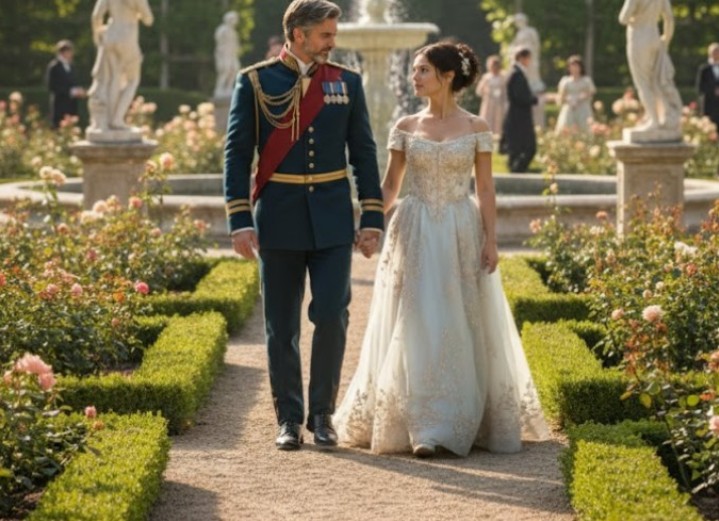
He danced with confidence and precision, as if his body remembered everything. His hand at her waist was firm, respectful. He did not stumble. He did not miss a step. And if someone had closed their eyes, they would not have guessed which of them could not see.
The whispers returned, but Emilia no longer heard them. She looked only at the man beside her — the one the hall had chosen not to see.
After that evening, they began to meet — quietly, without haste, without curious eyes. At first, there were walks in the garden, where the duke learned to know the world through sounds and scents, and Emilia learned to speak aloud what she had long kept inside. Then came long conversations, where neither needed to pretend.
He spoke of life after losing his sight — how people first pity you, then grow tired of that pity, and finally simply turn away.
She spoke of what it feels like to be “invisible” — seen, yet not considered important.
They came to know each other slowly. And in that slowness, trust was born.
One day, the duke said:
“You know, Emilia… you were the first person in many years who didn’t speak to me carefully. You spoke honestly.”
She smiled.
“And you are the first who looked at me as if I mattered more than my name — and my lack of a dowry.”
He reached out his hand — not as a duke, not as someone in need of help, but as a man. Emilia placed her hand in his — without fear, without hesitation.
“I do not see you with my eyes,” he said softly. “But I know who you are. And if you choose to walk beside me, I promise: you will never be invisible.”
Emilia did not answer at once. She simply stepped closer.
Sometimes love does not begin with grand confessions or public promises.
Sometimes it begins with a simple gesture — an outstretched hand,
with the ability to see a person where others have turned away.
And that is why, in the memory of all who were in that hall that evening, what remained was not the dresses, nor the music, nor the titles —
but the moment when a girl approached the man everyone had turned away from —
and stayed.
And from that evening on, people spoke differently:
not of a blind duke, nor of a poor girl,
but of two people who found each other
because they chose to see with their hearts.


