

I am thirty-eight years old, and from the outside my life looks almost calm and orderly, as if everything had long been neatly arranged on shelves. Yet inside, there is still something that never became the past—it only learned how to stay silent and not interfere with breathing.
I live in my house, I work, I go through ordinary days, and even my father now lives with me in the guest room, because age and weakness have slowly made him dependent on me—just as I once depended on the decisions he made for me.
I was seventeen when I became pregnant, and there was no shouting or scandal in our house. My parents were the kind of people who replace emotions with action—quick and cold—so that nothing would disturb their outward, perfect order.
My mother made a few phone calls. My father simply stopped looking at me the way he used to, as if I had suddenly become something foreign and inconvenient. Soon after, I was taken away, told it was temporary, that it would be better this way, that I would understand everything later—though every word sounded like an attempt to silence me with a future I had not chosen.
The place was called a clinic, but in reality it was isolation—there were no phones, no visits, not even the simple right to ask what would happen next. Time there flowed as if it had learned to make pain quieter, but deeper.
I remember that day too clearly, when I heard his first and only cry—thin, alive, real—and that sound was the only proof that everything happening was not a dream or a mistake.
I tried to get up, I begged them to show me the child, I repeated the same words over and over until they began to lose meaning—but no one answered, as if silence were part of the treatment.
Then my mother came in, calm and composed, and said—as if reading from a prepared script—that the child had not survived. In that moment, the world did not collapse loudly—it simply lost its foundation.
I said that I had heard him.
She replied that I needed to rest.
Later they gave me something, and when I woke up, there was a sense of emptiness inside me that cannot be explained, because it does not resemble pain—it resembles the absence of oneself.
I kept asking where he was, and each time I was told to move on, not to ask questions, not to hold on to what no longer existed—until one day I stopped speaking about it aloud, because I understood that my words changed nothing.
Before they finally took me away, one nurse secretly returned and left me a piece of paper, whispering that if I wanted, I could write something for him.
I wrote one sentence:
“Tell him he was loved.”
I gave the note along with a small blanket I had sewn myself—blue, with yellow birds along the edges—the only thing that felt like a real connection between me and someone who had been taken from me.
Then everything disappeared, and I was told it was right, that it would be easier to forget—though forgetting never comes on command.
Life went on—too quickly and too smoothly—as if I had simply been taken out of one room and placed into another, without being given time to understand that the first one was still mine.
My mother died two years ago, and my father moved in with me later, when his health began to fail. Now he lives quietly, sometimes confusing days and names, but still remembering enough to remain silent about what must not be spoken of.
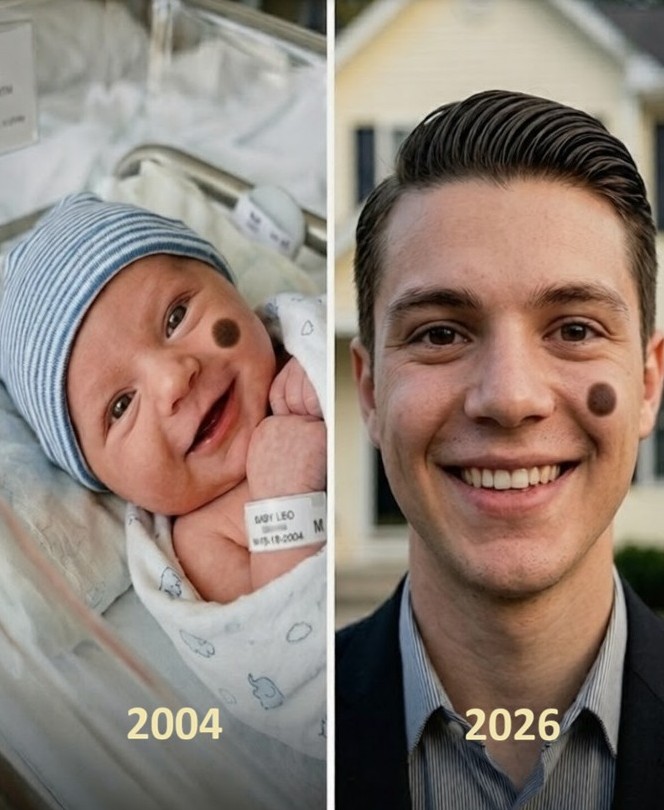
And then a new neighbor appeared next door.
I saw him for the first time as he was getting out of his car with boxes, and something inside me froze—because his face was too familiar, almost impossibly so.
Dark hair, sharp features, a look that seemed like a reflection of something I could never forget.
He smiled and simply said:
— Hi. I’m Miles. We’re neighbors.
I replied without understanding my own words, then returned home with the feeling that the air had become heavier.
Two days later he knocked on my door and offered coffee, saying he had made too much, and I agreed—though I should have refused.
When I entered his house, everything inside me stopped completely, because draped over the back of a chair was the same blanket—blue with yellow birds—the one that was supposed to have been destroyed.
I couldn’t help but ask:
— Where did you get that?
He answered calmly, as if it were something ordinary:
— I’ve had it my whole life.
Then he added that he had been adopted in his first days of life, and that he had always had only one note with him—the only connection to his past.
I already knew where this was going before he spoke the next words.
He said:
— “Tell him he was loved.”
The silence that followed was different—not empty, but dense, alive, as if the whole room held the breath of twenty-one years.
And at that moment, my father walked in.
He stopped in the doorway, saw both of us, and seemed to understand immediately that there was no turning back.
He was silent for a long time. Then he slowly sat down, as if the weight of his entire life had fallen on him, and for the first time he did not try to hide anything.
— He wasn’t taken — he said hoarsely. — He was given away.
And the truth he spoke did not sound like justification. It sounded like the end of silence.
Miles stood still, but something changed in his face—not suddenly, but the way a person changes when they finally recognize the direction of the road they have been walking their whole life.
He looked at me and said quietly, without pressure, without asking:
— I’ve been looking for you my whole life.
And suddenly I understood that this is not a story about loss.
It is a story about a path that was not broken—only hidden.
I couldn’t answer immediately. Everything inside me still clung to the old version of the world, where answers are impossible.
But then I said:
— I thought you didn’t survive.
He shook his head slightly, as if it were the simplest misunderstanding in the world.
— I survived — he said. — And all this time, I was walking toward you.
My father lowered his gaze, and in that movement there was no authority left—only exhaustion and the acceptance that some decisions cannot be kept secret forever.
Silence returned, but now it did not divide us. It gathered us.
And Miles, still standing in front of me, suddenly added calmly, with the simplicity that comes only after a long journey:
— The coffee has probably gone cold.
And in that ordinary sentence, there was no ending. For the first time in many years, something else appeared—not loss, not explanation, but the beginning of something that could no longer be erased or undone.


